
How DISC personality types can sharpen your marketing strategy
Most marketing advice focuses on what to say. DISC helps you think about who you're saying it to, and how they need to hear it. If you're working on your ideal client profiles or trying to understand why some messages land and others don't, this framework is worth understanding.
What is the DISC assessment?
DISC is a behavioural model that groups personality tendencies into four types: Dominance (D), Influence (I), Conscientiousness (C), and Steadiness (S). It's widely used in business contexts for team development and communication. What's less often discussed is how useful it is as a marketing tool, specifically when you're thinking about your buyer's mindset.
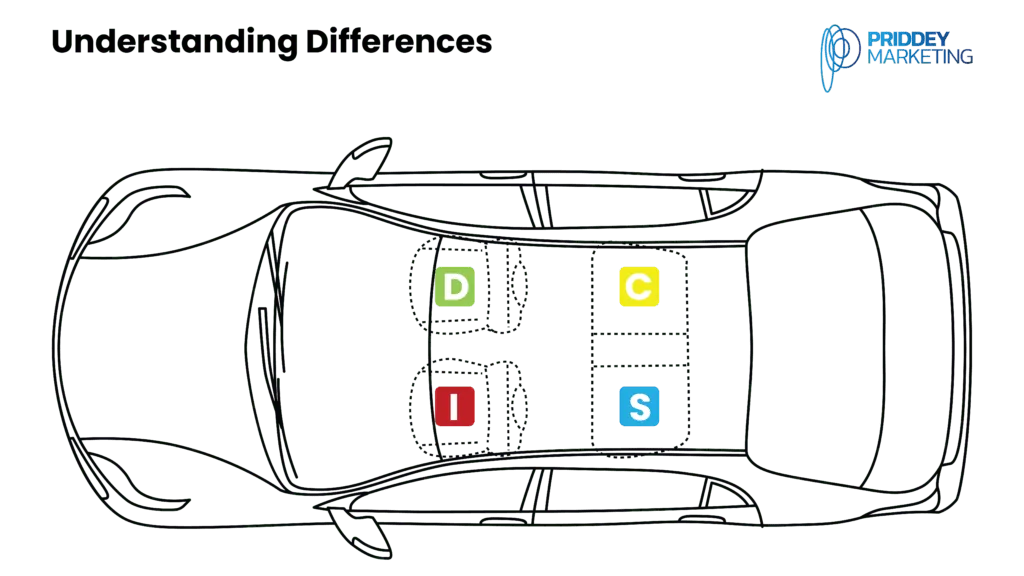
What is the DISC Car?
The DISC Car is a framework developed by Su Copeland at Priddey Marketing to make the four DISC types easier to understand in a business context. Think of your business as a car with four passengers, each playing a different role in the journey.
The Driver - D (Dominance). The D is at the wheel, focused on getting from A to B by the fastest route. They're decisive, results-oriented, and not particularly interested in the process as long as the outcome is achieved. In a business context, the D is often the CEO, the founder, or whoever is driving the company's direction.
The Front Passenger - I (Influence). The I is also focused on the destination, but they care just as much about the experience along the way. They're energetic, people-oriented, and want everyone in the car to be engaged and enjoying the journey. They're the ones changing the radio station, getting everyone singing along, and making sure the mood is right.
Behind the Driver - C (Conscientiousness). The C has done extensive research before the journey even began. They know the optimal route, the likely hold-ups, and how to shave time off the trip. They'll quietly point this out to the driver, who probably won't listen - classic back-seat driver territory. But when something goes wrong, the C is the one who knows how to fix it.
Behind the Passenger - S (Steadiness). The S, like the I, is focused on how everyone feels - but where I is energetic and expressive, S is calm and nurturing. They've brought sandwiches. They're checking that everyone's comfortable. They want the journey to go smoothly for all involved.
Why does this matter for your marketing?
No personality type is better or worse than another. All four are essential to a well-functioning business, and most buyers are a combination, though they'll typically have a dominant type with secondary traits. The point isn't to put people in boxes. It's to understand that the same message won't land equally well with all four types.
A Dominant buyer wants outcomes and efficiency. Tell them what the result will be, quickly, and don't bury it in process detail.
An Influential buyer wants to know how this will affect relationships, culture, or perception. They respond to stories, energy, and the human side of what you offer.
A Conscientious buyer needs evidence. If you don't give them enough detail, data, or proof of your methodology, they won't trust you - and they won't move forward.
A Steady buyer needs to feel safe. They want to know about the support, the relationship, and what happens after the sale. They're the ones reading case studies and testimonials carefully.
How do you apply this to your ideal client profiles?
Start by thinking about your best clients. How do they typically make decisions? Do they move quickly on gut instinct (D), get excited about the relationship and possibilities (I), ask detailed questions and want case studies (C), or take their time and consult others before committing (S)?
That gives you a picture of the personality type you're most often working with. From there, you can check your marketing messages against what that type needs to hear:
Are you leading with outcomes and being direct enough for a D?
Are you showing the human, relational side for an I?
Are you providing enough evidence and structure for a C?
Are you conveying warmth, support, and safety for an S?
Most STEM businesses default to detailed, technical content - which serves the C well but can lose everyone else. Broadening your messaging to cover all four types, without making it generic, is where the real difference shows up.
What does a more nuanced message look like in practice?
Imagine you're writing a page about your engineering consultancy services. A D-focused message leads with what clients achieve and by when. An I-focused message brings in client stories and the collaborative nature of the work. A C-focused message details the methodology, accreditations, and data behind outcomes. An S-focused message speaks to the ongoing relationship, the support structure, and what working together actually feels like.
You don't need four separate pages. You need one page that's layered well enough to speak to all four. That's what well-structured marketing does.
Where does this fit in your wider marketing strategy?
DISC works alongside your ideal client profile work, not instead of it. Once you know who your best clients are in terms of sector, size, and challenge, DISC adds a behavioural dimension. It helps you go from knowing what they do to understanding how they think and what they need from you before they'll say yes.
If you'd like to work through this for your own business, book a 30-minute call with Su to explore how the DISC Car framework applies to your ideal clients and your marketing messages.